
Jian Shou Qing Historical Roots & Folklore
While Lanmaoa asiatica was only recognized by modern western science recently, its unique psychological effects have been documented across separate cultures and centuries
- Ancient China (3rd Century CE): A prominent Daoist text describes a mysterious “flesh spirit mushroom”. The text notes that if consumed raw, it allows the eater to “see a little person” and “attain transcendence immediately”, mirroring modern poisoning reports with uncanny accuracy.
- Papua New Guinea (1930s–1960s): Western explorers and ethnomycologists (including Gordon Wasson and Roger Heim) documented a phenomenon termed “mushroom madness”. High mountain communities consumed a wild mushroom called nonda, causing temporary delirium and behavioral shifts. Though Albert Hofmann (the discoverer of LSD) tested samples at the time, he found no known compounds, leading researchers to dismiss the events as cultural folklore.
- The Philippines: Indigenous cultures in the remote Northern Cordillera region have long reported identical, highly specific visions of small people after eating a mushroom they call sedzdem (their native word for “little people”) youtube…
Botanical Profile & Taxonomy
For decades, the specific fungus behind these occurrences evaded precise scientific classification wikipedia readmore…
- The 2015 Classification: It wasn’t until 2015 that Chinese mycologists officially created the genus Lanmaoa and described Lanmaoa asiatica as a distinct species. Previously, it was misidentified as European lookalikes or classified simply as a subset of the broader Boletus genus.
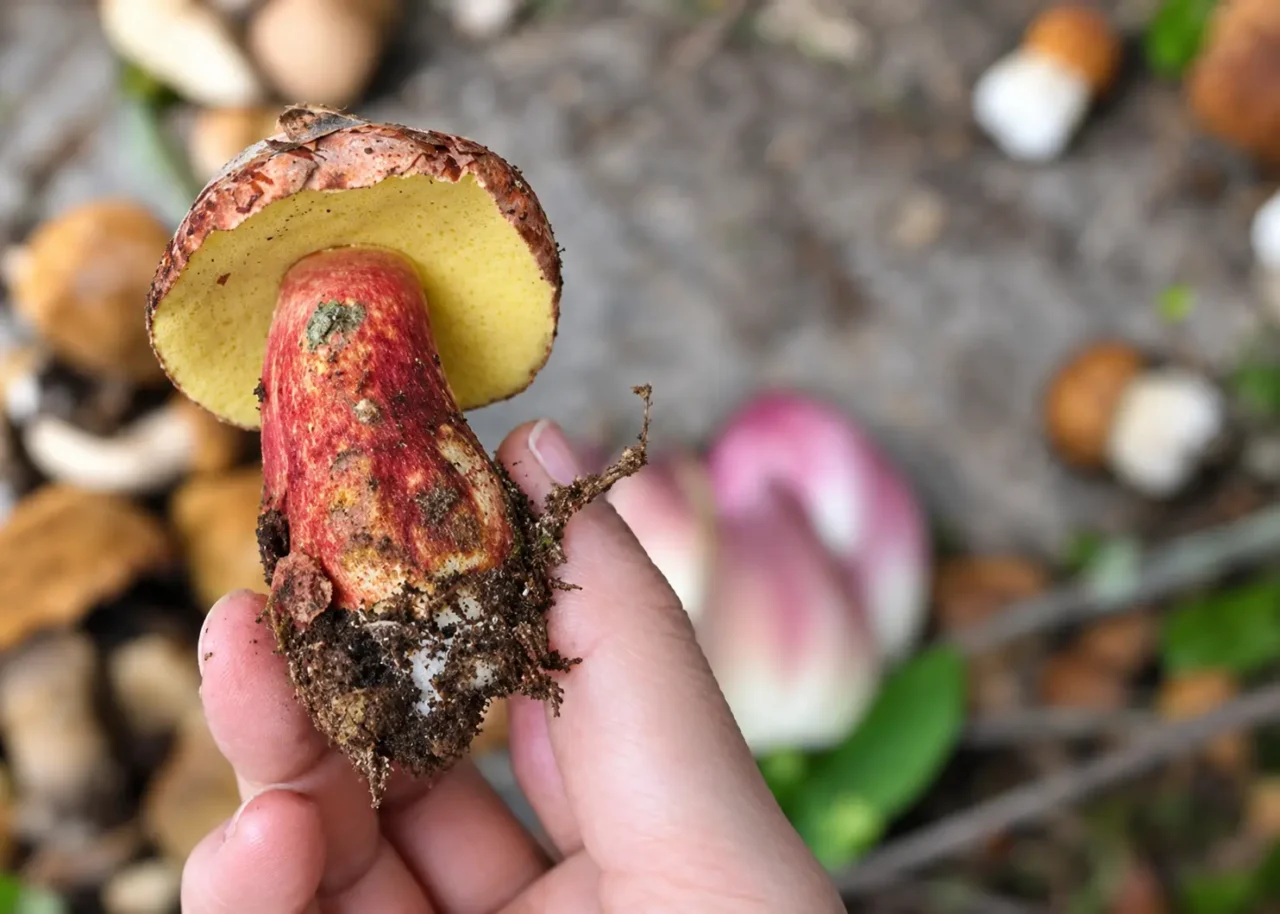
- Physical Characteristics: The mushroom is characterized by a distinctive brick-red cap, yellow pores, and a coral-to-red stipe (stem). When bruised, sliced, or touched, its tissue undergoes an instant, dramatic chemical reaction, oxidizing to an intense blue-black color.
- Ecology: L. asiatica is an ectomycorrhizal fungus, meaning it survives via a vital symbiotic relationship with tree roots, specifically the Yunnan Pine (Pinus yunnanensis). Because it cannot yet be artificially cultivated, it must be hand-foraged in wild pine forests during the wet summer months (June to September).
The Science of “Little People” Hallucinations
When L. asiatica is properly cooked (usually boiled or fried thoroughly for at least 15 minutes), its toxic components break down completely, rendering it a highly sought-after, savory, umami-rich culinary treat. However, if it is prepared poorly, undercooked, or eaten raw, it triggers a remarkably predictable medical event: BBC readmore…
| Attribute | Clinical Reality |
|---|---|
| Symptom Prevalence | Studies show that 69% to 96% of affected individuals report the exact same visual manifestations. |
| Visual Nature | Unlike traditional psychedelics that produce shifting abstract geometry or emotional distortions, L. asiatica produces Lilliputian hallucinations. These are stable, three-dimensional, highly detailed miniature humanoids, often described as elves, clowns, or tiny spirits about 2 cm tall. |
| Environmental Interaction | The tiny figures are perceived as interacting directly with the physical environment—marching under doors, climbing furniture, dancing on clothes, or swimming inside soup bowls. They become even more vivid when patients close their eyes. |
| Duration & Physical Toll | The experience can last anywhere from 24 hours to several days. It is frequently accompanied by physiological distress, including dizziness, disorientation, nausea, vomiting, and diarrhea. |
The Modern Biochemical Mystery
In 2026, a groundbreaking genetic and chemical study led by mycologist Bryn Dentinger and researcher Colin Domnauer at the University of Utah mapping the genome of L. asiatica upended the scientific understanding of psychedelics
- Zero Known Compounds: Researchers confirmed that L. asiatica contains none of the psychoactive chemicals known to science. Its genome completely lacks the four-gene pathway required to synthesize psilocybin (found in magic mushrooms) and the seven-gene pathway required to make ibotenic acid/muscimol (found in Amanita muscaria).
- Porcini Lineage: Phylogenetically, it is closely related to the common, non-psychoactive Porcini mushroom. This indicates that its ability to alter human consciousness evolved along an entirely unique, separate evolutionary branch.
- Novel Brain Pathways: Scientists have isolated roughly 20 distinct compounds from the mushroom—four of which are entirely new to science. Because the hallucinations are so visually identical across completely different global cultures, researchers believe the active compound acts on a highly specific, unmapped neurological pathway.
Mycology and neuroscience researchers are actively studying L. asiatica extracts to identify this hidden molecule. Pinpointing how it forces the human brain to uniformly build three-dimensional, miniature realities could unlock therapeutic breakthroughs for complex neurological conditions, sleep disorders, and cognitive diseases.
3 comments
Geovanni Considine
25/01/2018 at 9:35 am
The blue-bruising reaction (Jian shou qing) is usually caused by the oxidation of pulvinic acid derivatives when exposed to air. It’s crazy how a mushroom can look like a regular bolete but hold a biochemical secret that completely alters human consciousness.
Rita Thompson
25/01/2018 at 9:35 am
It’s fascinating that the toxin is heat-labile but completely unknown to modern toxicology. We are likely looking at a brand-new class of secondary metabolites. The race to isolate this compound could rewrite our understanding of neurotransmitter mapping
Grant Hagenes
25/01/2018 at 9:35 am
Hahaahah This is the ultimate high-risk, high-reward meal