

Industrial Scale-Up Costs and Yield Calculations for Blue-Staining Alternative Mushrooms
🏗️ 1. Facility Architecture & Capital Expenditure (CapEx) Modeling
-
- Zone A: Media Preparation & Substrate Siphon (1,000 sq. ft.): Unclassified gray zone. Housing for industrial mixers, automated bag-filling equipment, and substrate hydration lines.
- Zone B: Sterilization & Bulk Autoclaving (500 sq. ft.): Transitional thermal processing zone. Houses high-capacity, dual-door pass-through steam autoclaves.
- Zone C: Sterile Inoculation Cleanroom (500 sq. ft.): ISO Class 5 (Class 100) cleanroom environment. Operates under constant positive pressure (+30 Pa) with a dedicated vertical laminar flow HEPA ceiling matrix (99.99% efficiency at 0.3 microns).
- Zone D: Incubation & Mycelial Colonization Vaults (1,500 sq. ft.): ISO Class 7 cleanroom equivalent. Climate-controlled dark rooms operating under neutral pressure, optimized for vegetative growth.
- Zone E: Controlled Environment Fruiting Chambers (CEFC) (1,500 sq. ft.): Split into three independent rooms. Features vertical racking arrays, variable-frequency drive (VFD) HVAC systems, high-pressure ultrasonic humidification loops, and broad-spectrum LED array
🧪 2. Substrate Optimization & Operational Expenditure (OpEx)
-
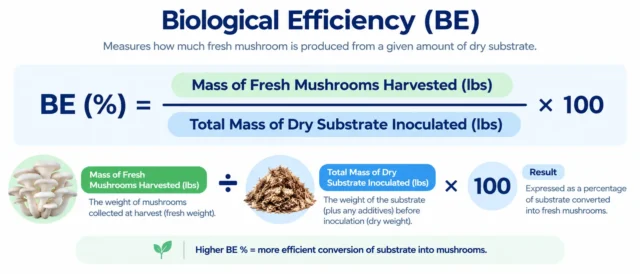
- Industrial Baseline Expectation: While standard Oyster mushrooms hit up to 100% BE, specialized blue-staining alternatives achieve a lower, more premium 45% to 60% BE due to their evolutionary wild nature.
Formula 2: Substrate Yield Density (SYD)
This determines the output per individual standard production block. The industry baseline utilizes a standard 5.5 lb (2.5 kg) wet substrate block formulated at 60% moisture content.
- Dry Weight Calculation per Block:
5.5 lbS Wet Substrate X 0.40 (dry solid content)= 2.2 lbs dry solid substrate
- Fresh Mushroom Output per Block (at 50% target BE):
2.2 lbS Dry Substrate X 0.50 (BE)= 1.1 lbs of fresh solid per block
Annual Production Throughput Matrix
To hit the target of 50,000 lbs of premium fresh mushrooms annually, we work backward through the mass balance equations: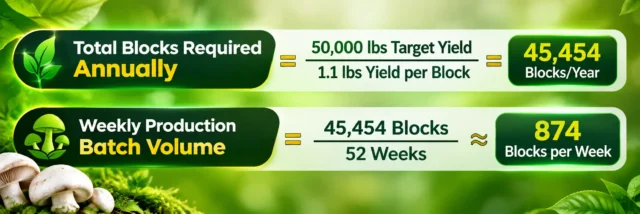
📈 4. Multi-Phase Growth Environment Metrics
[Phase 1: Incubation] ──(21-28 Days)──> [Phase 2: Primordia Pinning] ──(5-7 Days)──> [Phase 3: Fruiting Development]
| Environmental Parameter | Phase 1: Mycelial Incubation | Phase 2: Primordia (Pinning) Induction | Phase 3: Fruiting Body Development |
|---|---|---|---|
| Air Temperature | 74°F – 77°F (23°C – 25°C) | 61°F – 64°F (16°C – 18°C) | 65°F – 68°F (18°C – 20°C) |
| Relative Humidity (RH) | 60% – 65% | 95% – 98% (High Fog) | 88% – 92% |
| Carbon Dioxide (CO₂) | 3,000 – 5,000 ppm (High) | 600 – 800 ppm (Fresh Air Shock) | 800 – 1,100 ppm |
| Lighting Spectrum / Lux | Complete Darkness (0 Lux) | 4,000K Cool White (500 Lux) | 4,000K–6,500K (800 Lux) |
| Photoperiod Cycle | 0 Hours Light / 24 Hours Dark | 12 Hours Light / 12 Hours Dark | 12 Hours Light / 12 Hours Dark |
| Total Phase Duration | 21 – 28 Days | 5 – 7 Days | 7 – 10 Days |
💰 5. Revenue Generation & Return on Investment (ROI) Projections
-
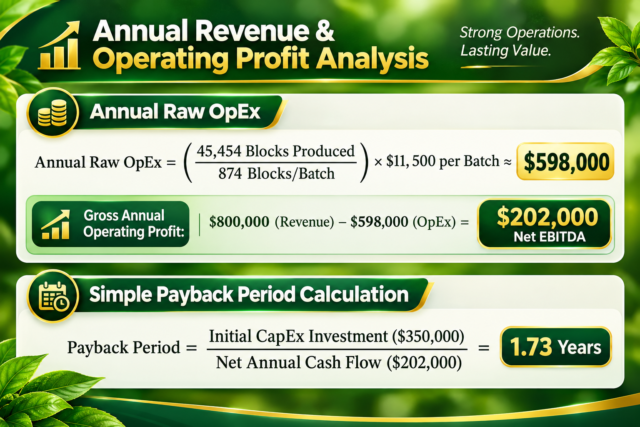
- Average Wholesale Market Price: $16.00 per lb (Blended rate across restaurant and distribution networks).
- Total Annual Yield Capacity: 50,000 lbs fresh weight.
- Gross Revenue Potential: $16.00 × 50,000 = $800,000 per year.
How to Source Lanmaoa asiatica Safely
Welcome to LanmaoaAsiatica Co. A premier botanical sourcing directory and specialized mycological research development network. Our mission bridges the gap between global mycological curiosity and safe, legal Jian Shou Qing dehydrated resources. Specifically, we cater to microscopic hobbyists, chefs and culinary agricultural enthusiasts seeking rare fungus.
3 comments
Esta Reinger
25/01/2018 at 9:35 am
the Biological efficiency and calculation methods of the whole structure is accurate
Jaquelin McDermott IV
25/01/2018 at 9:35 am
this was very helpful, thanknyou for this breakdown
Cassandre Hermann
25/01/2018 at 9:35 am
there is just too much helpful info. kudos